
Editing videos and podcasts doesn’t have to feel like a technical headache anymore. If you’re tired of cutting clips manually, fixing messy audio, writing captions, and spending hours on small edits, this Descript Review 2026 will help you decide whether this AI-powered editor is the right tool for your workflow. 🎙️🎬⚡
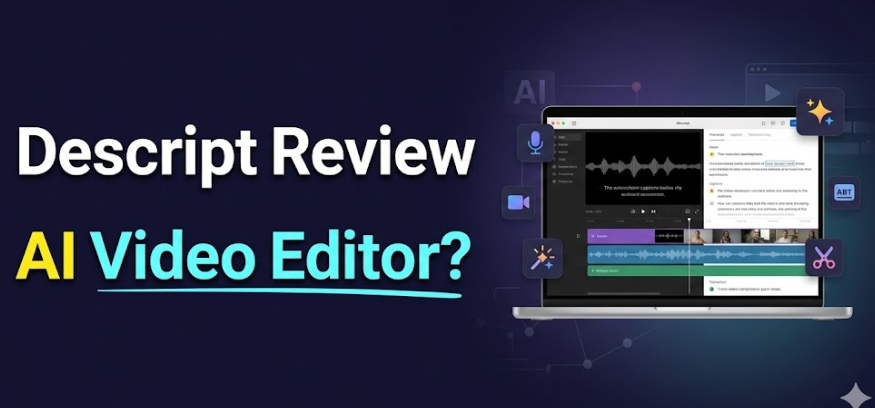
Descript has become popular because it makes audio and video editing feel as simple as editing a text document. You can transcribe your content, remove filler words, clean poor audio, add captions, create short clips, and edit podcasts or videos faster with AI tools.
In this review, we’ll break down Descript pricing, features, pros and cons, transcription quality, real use cases, and alternatives so you can clearly understand whether Descript is worth it for podcasters, YouTubers, marketers, educators, and content teams.
Let’s explore what Descript really offers before you choose a plan.
What Is Descript? — Overview & Key Features 🎙️
So what actually is Descript?
At its heart, Descript is an AI-powered audio and video editing platform that ditches the traditional timeline-first approach. Instead of cutting waveforms with a razor tool, you edit the transcript and the software automatically chops up the underlying media to match. Think of it like editing a Word document, except every word is a clip and deleting something actually removes the audio and video.
Here is the official definition: Descript is an AI-powered platform where your spoken words not your timeline are the primary editing interface. Upload a recording, Descript transcribes it (using OpenAI’s Whisper speech recognition engine), and from that point forward, your project exists simultaneously as a text document and a video timeline. Changes you make to one propagate automatically to the other.
Who is Descript built for?
- Podcasters who want to edit hours of raw audio in minutes
- YouTubers making talking-head videos, tutorials, or reviews
- Course creators producing educational content
- Marketing teams repurposing webinars into short social clips
- Remote teams collaborating on video projects
- Solopreneurs who do everything themselves
The main value prop? Speed. Real creators report cutting average editing time by 47% across real-world projects, with transcription accuracy hitting 97–99% on clean audio.
Let’s talk about what you actually get inside the app.
Descript Features In-Depth — What Sets It Apart 🛠️
Let’s get into the guts of the software. These are the features that make Descript either your new best friend or your occasional headache.
1. Text-Based Editing (The Killer Feature) ✂️
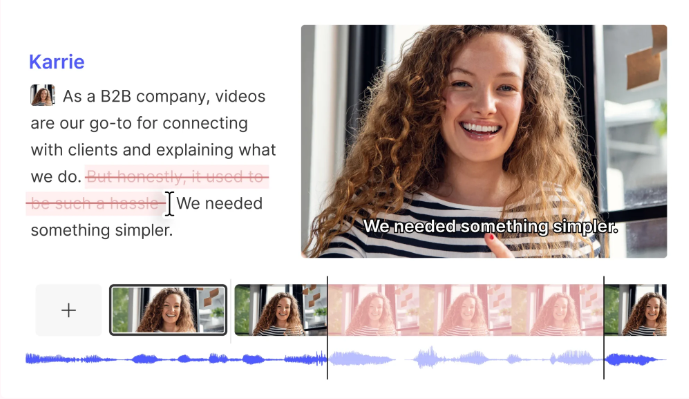
This is the headline act. Instead of cutting and trimming in a timeline, you edit the transcript. Delete a word, and that word disappears from your audio. Move a paragraph, and the video clips shuffle accordingly. It is revolutionary for long-form content like podcasts and interviews.
Real example: You have a 60-minute interview. The guest says “uh” 80 times. Instead of listening for every “uh” and slicing manually, you can remove them all in three clicks with filler word detection. Instead of hunting visually for where the guest answered the question, you just search the transcript text. Game-changer.
2. AI Transcription (Whisper-Powered) 📝
Descript uses OpenAI’s Whisper engine for transcription — the same tech powering advanced voice recognition. Accuracy on clean audio is 97–99% . Heavy accents, multiple simultaneous speakers, or poor audio quality will drop that number, but for most creators, it is outstanding.
What you can transcribe: Audio files, video files, screen recordings, and remote recordings from Descript Rooms.
3. Overdub — AI Voice Cloning 🗣️
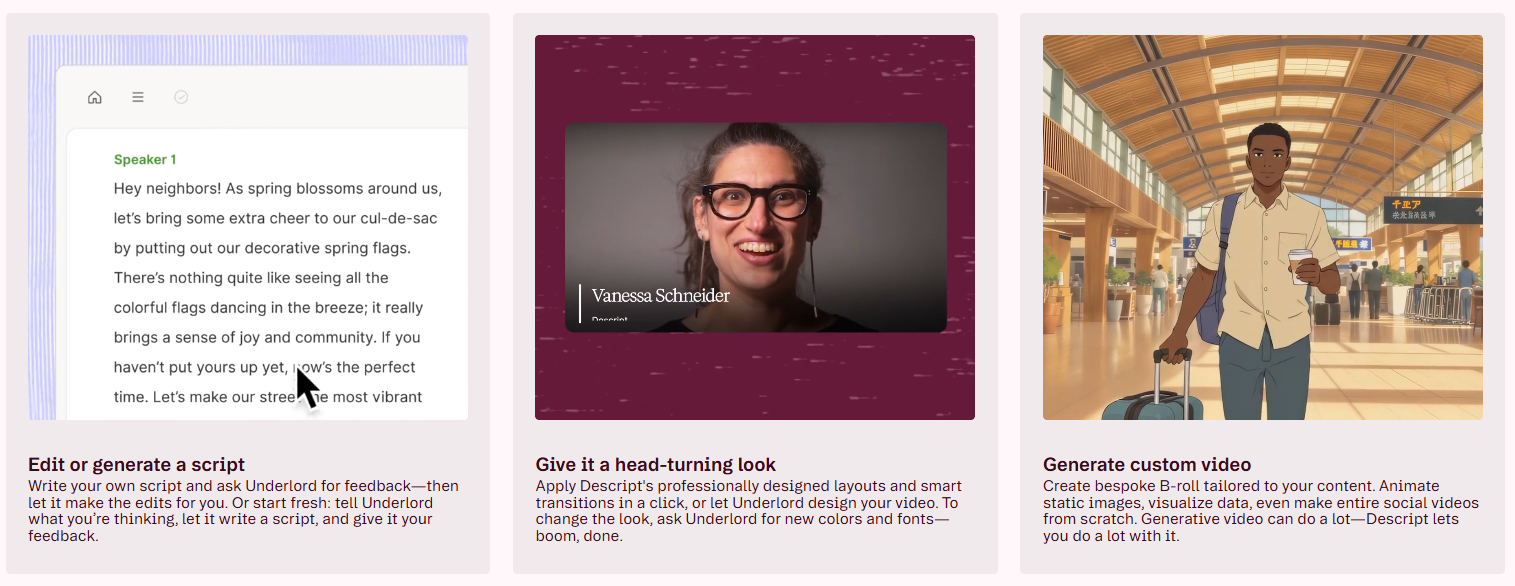
Spent twenty minutes recording a perfect take… except you mispronounced “entrepreneur.” Normally? You re-record. With Overdub, you type the correct word, and Descript generates it in your voice using AI voice cloning.
2026 update: Descript rolled out a new AI model for Regenerate that preserves natural intonation and pacing much better than before. Replacement audio now sounds closer to your original speaking style.
Caveats: Overdub requires training samples (you reading a script). It consumes AI credits. And it works best for short corrections (words/phrases), not entire paragraphs.
4. Studio Sound — One-Click Audio Enhancement 🎧
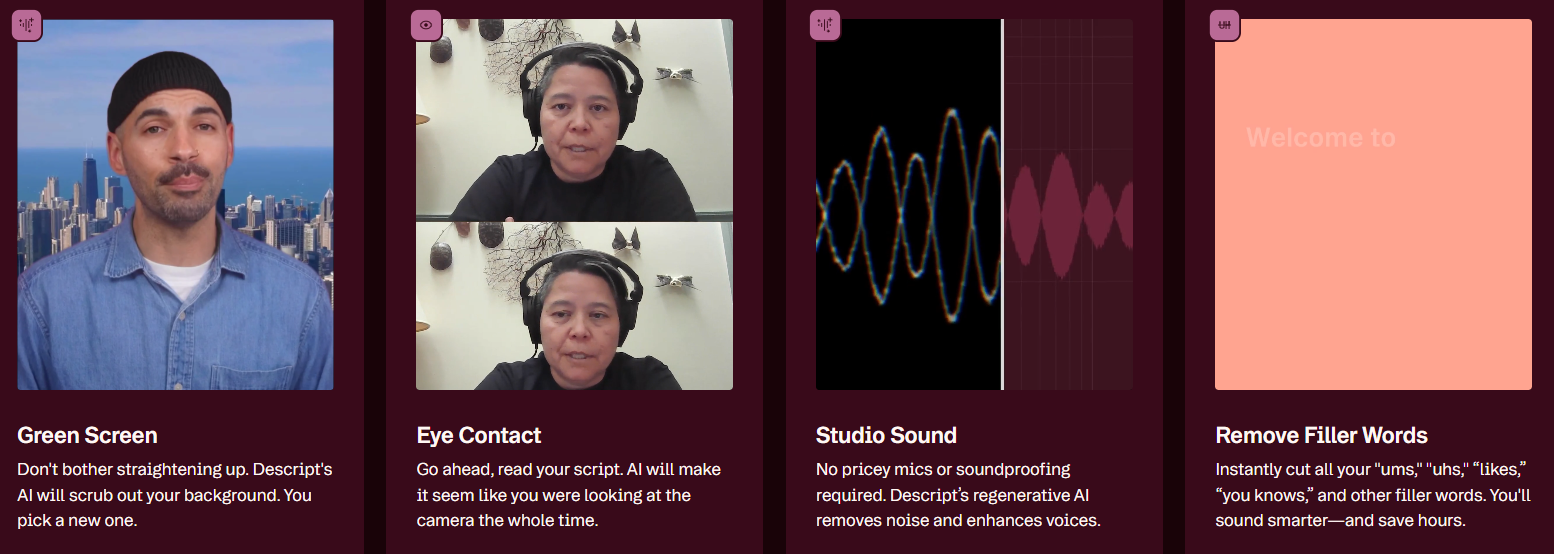
If you have ever recorded audio in a room with bad acoustics, Studio Sound is your hero. It automatically reduces background noise, improves vocal clarity, adds tonal balance, and reduces echo.
Real-world test: A reporter records a field interview near a busy street. One click of Studio Sound, and the traffic is gone, the voice is clear. No audio engineering degree required.
5. Filler Word Removal — Clean Up Fast 🤐
“Um,” “uh,” “like,” “you know” — gone. One button finds them all and deletes them in bulk (with optional individual review). For podcasters and YouTubers producing weekly content, this feature alone can shave hours off the editing process.
6. Underlord — The AI Co-Editor 🤖
This is Descript’s most ambitious 2026 feature. Underlord is an AI assistant embedded right inside the editor. It can:
- Add logos, zooms, and scenes
- Apply transitions automatically
- Remove filler words (43% improvement over previous models)
- Place B-roll (accuracy jumped from 60% to 92%)
- Generate video from text prompts
You can even choose which AI model powers Underlord: Claude Opus 4.6 (best for visuals), Claude Sonnet 4.6 (best for complex instructions), or Google Gemini 3.1 Pro (cost-effective for long projects).
7. Media Library (New in March 2026) 📚
A major feature request finally landed in 2026: The Media Library. You can now upload and organize media at the drive level — videos, images, and audio — making it easy to reuse assets across multiple projects. No more re-uploading the same intro video or logo fifty times.
8. Captions and Subtitles — One-Click Accessibility 📝
Descript generates captions automatically (using that Whisper transcription). You can adjust styles, fonts, colors, and positioning — and then export as SRT, VTT, or burned-in captions. Perfect for YouTube, TikTok, and accessible content.
9. Screen Recording + Webcam Capture 🖥️
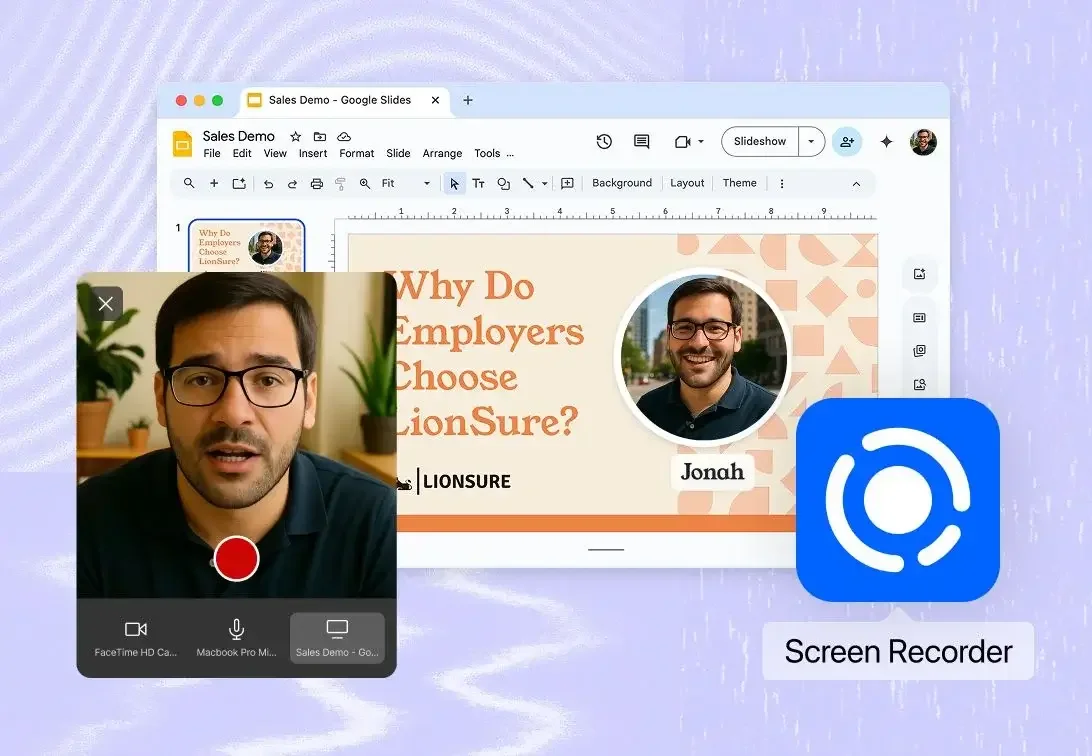
Need to record a tutorial, a sales video, or a presentation? Descript’s built-in screen recorder captures both screen and webcam simultaneously (picture‑in‑picture). And since the whole thing lives inside the editor, you can trim, add captions, and export without switching apps.
10. Remote Recording — Descript Rooms 🎙️
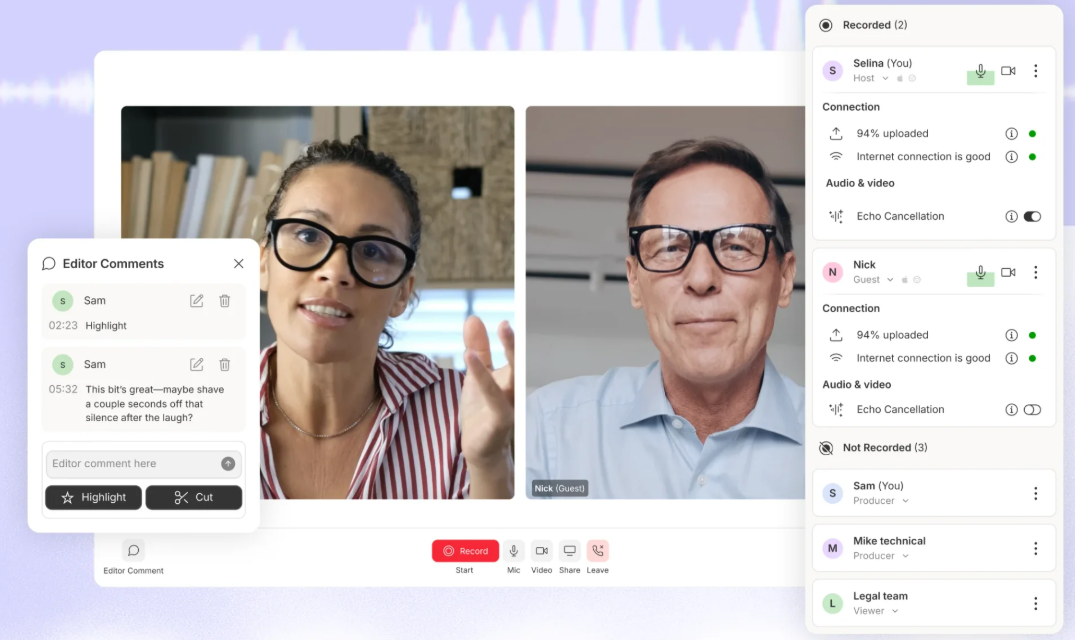
Descript Rooms let you record high-quality remote interviews with guests anywhere in the world. Separate audio tracks for each participant, local recording for quality, and automatic transcription — all inside the same ecosystem.
Descript Pricing & Plans — Which One Is Worth It? 💰
Descript pricing is based on plan level, media hours, AI credits, export quality, collaboration features, and team needs.
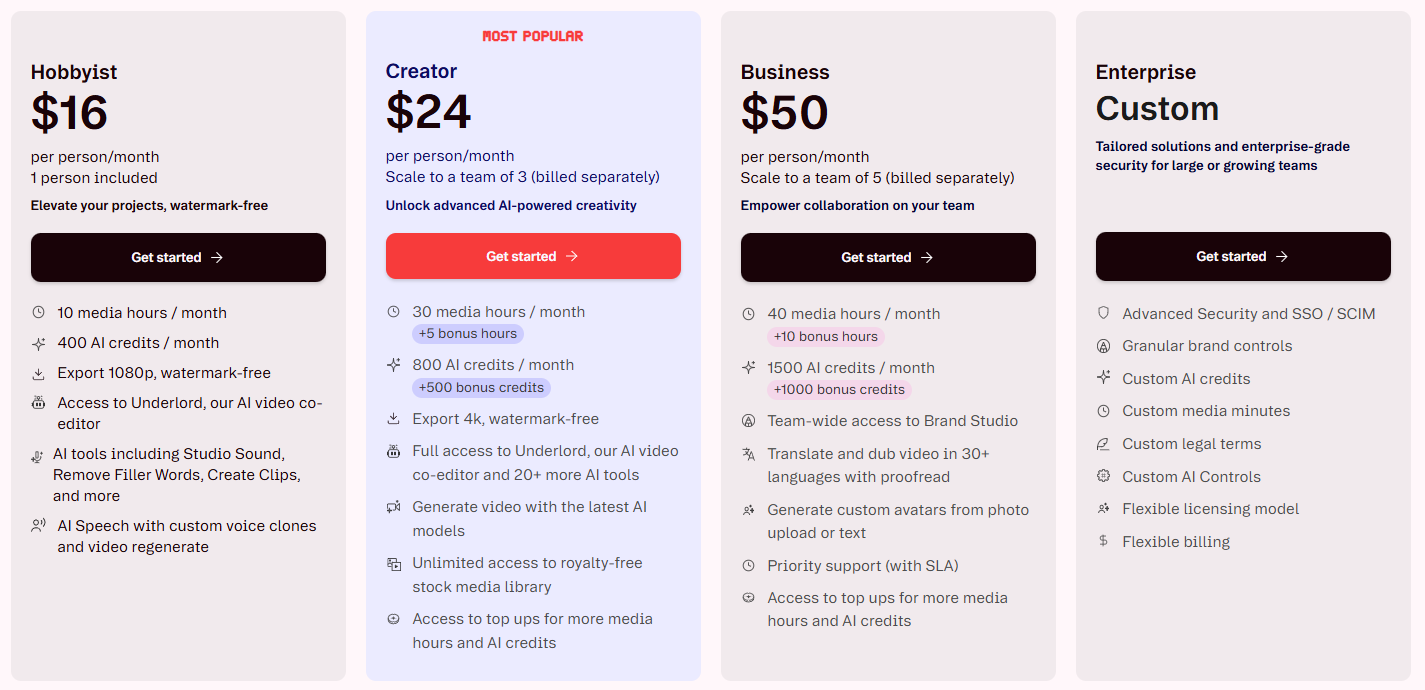
Descript currently lists these main plans: Free, Hobbyist, Creator, Business, and Enterprise. The pricing page shows annual and monthly pricing, with annual billing saving up to 35%.
Descript Pricing Comparison Table
| Plan | Price | Media Hours | AI Credits | Export Quality | Best For |
|---|---|---|---|---|---|
| Free | $0/month | 1 media hour/month | 100 AI credits/month | 720p, watermark-free | Testing Descript |
| Hobbyist | $16/month annual or $24 monthly | 10 media hours/month | 400 AI credits/month | 1080p, watermark-free | Solo creators |
| Creator | $24/month annual or $35 monthly | 30 media hours/month + bonus hours | 800 AI credits/month + bonus credits | 4K, watermark-free | YouTubers, podcasters |
| Business | $50/month annual or $65 monthly | 40 media hours/month + bonus hours | 1,500 AI credits/month + bonus credits | 4K, team tools | Teams and agencies |
| Enterprise | Custom | Custom | Custom | Custom | Large teams |
Descript’s official pricing page lists the Free plan with 1 media hour/month, 100 AI credits/month, 720p watermark-free export, limited Underlord access, and a limited trial of AI Speech.
It lists Hobbyist with 10 media hours, 400 AI credits, 1080p export, Studio Sound, Remove Filler Words, Create Clips, AI Speech, and custom voice clones.
Creator adds 30 media hours, 800 AI credits, 4K export, full Underlord access, 20+ AI tools, royalty-free stock media, and top-ups. Business adds 40 media hours, 1,500 AI credits, Brand Studio, translation and dubbing in 30+ languages, custom avatars, and priority support.
Descript Pros and Cons ⚖️
| Pros ✅ | Cons ❌ |
|---|---|
| Very easy text-based audio and video editing ✍️ | Advanced features may take time to learn 🧠 |
| Great for podcast editing and cleanup 🎙️ | Not as advanced as Adobe Premiere Pro or Final Cut Pro for cinematic editing 🎬 |
| AI transcription saves a lot of time 📝 | Transcription may still need manual correction ⚠️ |
| Studio Sound improves poor audio quality 🎧 | Internet connection is important for smooth use 🌐 |
| Filler word removal makes editing faster 🧹 | Removing too many filler words can make speech sound unnatural 🗣️ |
| Captions and subtitles are easy to create 💬 | Caption styling may need manual adjustment sometimes 📱 |
| Good for creating short clips from long videos ✂️ | Heavy users may need higher paid plans 💰 |
| Useful for YouTubers, podcasters, educators, and marketers 🚀 | Large projects can feel slow on some systems 🐢 |
| Collaboration tools are helpful for teams 👥 | AI voice tools may not always sound fully natural 🤖 |
| Saves time compared to traditional timeline editing ⏱️ | Not ideal for complex VFX, color grading, or high-end editing 🎞️ |
Descript vs Competitors — Head-to-Head Comparisons 🔥
Here is how Descript stacks up against the other heavy hitters in 2026.
| Tool | Best For | AI Features | Editing Style | Pricing (Starting) | Ease of Use | Best User |
|---|---|---|---|---|---|---|
| Descript 🎙️ | Podcasters, solo creators, talking heads | Underlord, Overdub, Studio Sound 🤖 | Transcript-first ✂️ | $12/month 💵 | High 👍 | Content creators, course makers |
| Adobe Premiere Pro 🎬 | Professional filmmakers, complex projects | Speech-to-Text, AI color, auto-reframe 🎛️ | Traditional timeline ⏱️ | $22.99/month 💳 | Low ⚠️ | Pro editors, agencies |
| Riverside 📹 | Remote interview recording | Text-based editing, AI clips, show notes 📝 | Recording-first 🎙️ | $15/month 💸 | Medium ➖ | Podcasters with remote guests |
| CapCut ✂️ | Short-form social media (TikTok, Reels) | Auto captions, text-based cuts, effects 🎛️ | Simple timeline 🧩 | Free / $8/month 🆓➡️💵 | Very High 🚀 | Social media creators |
| Audacity 🎧 | Free basic audio editing | Minimal (plugins available) 🔌 | Waveform editing 📈 | Free 🆓 | Medium ➖ | Beginners on a budget |
| DaVinci Resolve 🎨 | Color grading and professional post-production | Transcription, AI dialogue isolation 🧠 | Traditional timeline ⏱️ | Free (Studio $295) 💰 | Low ⚠️ | Film editors, colorists |
| Otter.ai 🗒️ | Transcription first, editing second | AI transcriptions, summaries, speaker ID 🧾 | Transcript viewer 📚 | $16.99/month 💵 | High 👍 | Meeting recorders, journalists |
Where Descript Wins 🏆
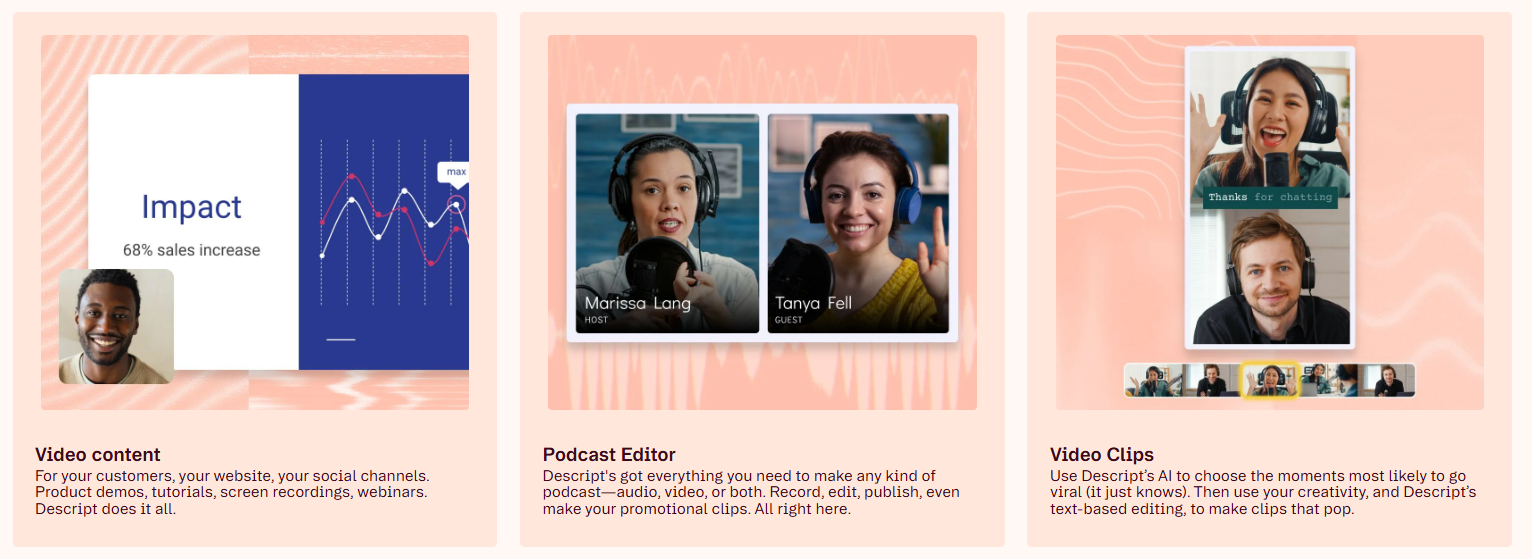
- Text-based editing is transformative for narrative content. If your primary output is talking‑head videos, podcasts, tutorials, or interviews — Descript is uniquely fast.
- All‑in‑one workflow. Recording → transcription → editing → AI polish → export. No jumping between Audacity (audio), Premiere (video), and Otter (transcripts).
- Best for solo creators and small teams. The learning curve is gentle, and the AI tools handle tasks that would require a whole team a decade ago.
Who Should Use Descript? Ideal Users 👤
✅ You Should Use Descript If…
🎙️ You are a podcaster
Descript is great for editing long audio, removing filler words, cutting mistakes, cleaning sound, and creating show notes faster.
📹 You make talking-head videos
It works well for tutorials, reviews, educational videos, and scripted content because you can edit by deleting text from the transcript.
🏫 You create courses or training videos
Screen recording, webcam capture, captions, and branded templates make it useful for lessons, onboarding, and training content.
🤖 You are a solo creator
If you handle recording, editing, and publishing alone, Descript’s AI tools can save a lot of time.
👥 You work with a small team
Teams can share projects, leave comments, and collaborate without messy file versions.
❌ You Should Look Elsewhere If…
🎬 You need advanced video editing
For cinematic edits, multi-camera projects, motion graphics, or deep color grading, Premiere Pro, Final Cut Pro, or DaVinci Resolve are better.
📱 You only make short-form clips
If your only focus is TikTok, Reels, or Shorts, CapCut may be faster and cheaper.
🎧 You need professional audio engineering
For advanced EQ, compression, mastering, or spectral editing, Adobe Audition or a full DAW is better.
💰 You need a completely free tool
If budget is $0, Audacity is a better free option, though it is less beginner-friendly than Descript.
Real-World Use Cases — How Creators Use Descript 🧪
🎙️ 1. Editing a Podcast Episode
Instead of manually cutting every “um” in Audacity, upload your audio to Descript, auto-transcribe it, remove filler words, delete weak parts from the transcript, and export faster.
Best for: podcasts, interviews, and long audio edits.
📲 2. Turning Webinars into Social Clips
Upload a webinar, search the transcript for strong moments, highlight key sections, and use Descript to create short captioned clips.
Best for: Reels, Shorts, TikTok, and LinkedIn clips.

🎧 3. Cleaning Poor Audio
Recorded in a noisy room? Studio Sound can reduce background noise, echo, and weak voice quality with one click.
Best for: podcasts, courses, interviews, and voiceovers.
🎬 4. Creating YouTube Tutorials
Record your screen and webcam, edit mistakes from the transcript, add captions, and export a clean tutorial video.
Best for: software tutorials, product demos, and training videos.
Descript Review — User Ratings & Testimonials ⭐
Descript gets strong feedback from creators who like its text-based editing, transcription, captions, Studio Sound, and time-saving AI tools.
✅ Users Like
- Easy transcript-based editing ✍️
- Fast podcast and video cleanup 🎙️
- Helpful filler word removal ✂️
- Good captions and subtitles 💬
- Time-saving AI features ⚡
❌ Users Complain About
- Pricing confusion 💰
- Occasional bugs 🐞
- Sync/export issues 🔧
- AI transcription mistakes 📝
- Slow performance on large projects 🖥️
Bottom line: Descript is loved by podcasters, YouTubers, and solo creators, but heavy users may face pricing and performance issues.
Tips & Tricks for Getting the Most Out of Descript 🧠
Descript is easy to use, but if you use it smartly, you can save a lot of editing time and get cleaner results. Here are some practical tips: 👇
1. Clean Your Audio Before Editing 🎙️
Before you start cutting or editing, make sure your audio is clear. Use a good microphone, record in a quiet room, and remove background noise where possible. Cleaner input gives you better transcription and smoother final output.
2. Use Studio Sound Carefully 🎧
Studio Sound can make bad audio sound much cleaner, but don’t overuse it. Sometimes it can make voices sound too processed or unnatural. Use it lightly and always listen before exporting.
3. Review AI Transcription Manually 📝
Descript’s transcription is helpful, but it may still make mistakes with names, accents, technical words, or fast speech. Always check the transcript before deleting words or editing the video.
4. Create Templates for Repeated Videos 🎬
If you make YouTube videos, podcasts, reels, or tutorials regularly, create reusable templates. Add your intro, outro, captions style, logo, and brand colors once, then reuse them for future projects.
5. Use Filler Word Removal Carefully ✂️
Removing “um,” “uh,” and repeated words can make your video cleaner, but removing too many can make speech sound robotic. Review the edits before applying them everywhere.
6. Export Clips in Platform-Specific Formats 📱
For YouTube, use landscape format. For Instagram Reels, TikTok, and Shorts, export in vertical format. This helps your clips look professional on each platform.
7. Keep Projects Organized 📂
Name your files, folders, scenes, and versions properly. For example:
Podcast Episode 01_Final, YouTube Intro, Short Clip 1.
This saves time when working on multiple videos or team projects.
Common Issues & How to Fix Them 🔧
Even though Descript is powerful, users may face a few common problems. Here’s how to solve them quickly:
1. Transcription Mistakes 📝
Problem: Descript may mishear names, brand terms, accents, or technical words.
Fix: Review the transcript manually and correct important words before editing or exporting.
2. Export Issues 📤
Problem: Video may take too long to export or fail during processing.
Fix: Check your internet connection, reduce file size, close extra apps, and try exporting in a lower resolution first.
3. Audio Sync Problems 🎧
Problem: Audio and video may not match properly after editing.
Fix: Avoid making too many cuts at once. Check the timeline after major edits and manually adjust the audio track if needed.
4. AI Voice Sounds Unnatural 🤖
Problem: Overdub or AI voice may sound robotic in some parts.
Fix: Use shorter sentences, add natural pauses, and avoid generating long paragraphs in one go.
5. Slow Performance 🐢
Problem: Large video projects may lag while editing.
Fix: Split long projects into smaller scenes, close background apps, and keep your browser or desktop app updated.
6. Caption Formatting Problems 💬
Problem: Captions may look too large, too small, or poorly placed.
Fix: Adjust font size, line spacing, and placement before exporting. Always preview captions on mobile size if you’re creating short-form videos.
Quick Tip 💡
Before exporting your final video, always watch the full preview once. It helps catch small mistakes in captions, cuts, audio, and transitions before publishing.
Final Verdict — Is Descript Worth It in 2026? 🏆
Yes, Descript is worth it in 2026 if you want a fast, beginner-friendly way to edit podcasts, videos, interviews, tutorials, and short-form clips. Its biggest strength is that it makes editing feel like editing a document — you can cut, remove, and rearrange audio or video by simply editing the transcript. 🎙️🎬
For podcasters, Descript is excellent because it offers transcription, filler word removal, multitrack editing, Studio Sound, and easy publishing tools. For YouTubers and short-form creators, it helps turn long videos into clips, add captions, clean audio, and create social-ready content quickly. 🚀
However, Descript is not perfect for everyone. If you need advanced color grading, heavy cinematic editing, complex motion graphics, or full professional timeline control, tools like Adobe Premiere Pro or Final Cut Pro may still be better. Descript is built more for speed, simplicity, AI editing, and content repurposing than high-end film editing. ⚖️
Best For
- Podcasters 🎧
- YouTubers 📹
- Course creators 🎓
- Marketing teams 📢
- Social media creators 📱
- Businesses creating training videos 💼
Not Best For
- Advanced filmmakers 🎞️
- Heavy motion graphics editors 🎨
- Users who need offline editing only 💻
- Creators who want full professional editing control ⚙️
Overall, Descript is one of the best AI-powered editing tools for creators who want to save time, clean up content faster, and repurpose videos across platforms. For most creators, teams, and podcasters, it offers strong value in 2026. ✅
“Must Read”:-
FAQs — Descript Quick Answers ❓
1. Is Descript free?
Yes. Descript has a Free plan with 1 media hour/month, 100 AI credits/month, 720p export, limited Underlord access, and a limited AI Speech trial.
2. Is Descript good for beginners?
Yes. Descript is beginner-friendly because you can edit audio and video by editing text instead of learning a complex timeline.
3. Is Descript good for podcast editing?
Yes. Descript is very strong for podcast editing, especially for interviews, filler-word removal, transcription, Studio Sound, and clip creation.
4. Can Descript edit videos?
Yes. Descript can edit videos, create captions, remove backgrounds, add layouts, create clips, generate video, and export up to 4K on higher plans.
5. How accurate is Descript transcription?
Descript transcription is useful and fast, but not perfect. You should manually review names, accents, brand terms, and technical words.

👨💻 Hi, I’m Anas Khan, a digital marketing expert with over 5 years of experience in e-commerce and affiliate marketing. I specialize in finding the best coupon codes 💸, Black Friday promotions 🛍️, and discount offers 💥 to help you save big!
I’ve dedicated myself to staying on top of the latest trends 📈 in online deals, so I can offer you the most reliable, tested advice. Whether you’re looking for promo codes or exclusive Black Friday deals, you can trust that my recommendations are based on solid research and personal expertise 🏆.